
Veneers
What are veneers, and how much tooth has to be removed?
Veneers are thin facings bonded to the front of teeth to change colour, shape or alignment. Composite veneers are hand-sculpted directly onto the tooth and usually need little or no drilling; porcelain veneers require more preparation.
 Before
 After
AfterWhat is the difference between composite and porcelain veneers?
They solve the same problem with opposite trade-offs. Composite veneers are built up from a tooth-coloured resin that the dental professional layers and sculpts directly onto your tooth, shaping and polishing it in the chair. Porcelain veneers are made by a technician in a laboratory from an impression or digital scan, then bonded at a later appointment.
Composite is additive. Because the material is placed onto the tooth rather than fitted over it, in many cases little or no enamel needs to be removed — which is why it appeals to a practice built around preserving structure. It is completed in one visit, and if it chips or wears at an edge it can usually be repaired in place rather than replaced entirely.
Porcelain is harder, holds its surface polish for longer and resists staining better than resin does. The cost is enamel: the veneer occupies physical space, so a defined thickness of tooth has to be reduced for it to sit within the tooth's original contour instead of bulking it out. That reduction is permanent, and it commits the tooth to being restored for the rest of its life.
Neither is simply better. Which is appropriate depends on how much you want changed, the state of the enamel, your bite, and how you weigh a reversible-in-principle option against a more durable surface.
- Composite — one appointment, sculpted chairside, minimal or no tooth preparation, repairable, lower cost
- Porcelain — two or more appointments, laboratory-made, requires enamel reduction, more stain-resistant, usually replaced rather than repaired
What problems can veneers actually solve?
Veneers change the visible front surface of a tooth, so they address problems that live on that surface or in the tooth's outline. Chipped or worn edges can be rebuilt. Small gaps between front teeth can be closed. Teeth that are slightly rotated or set back can be made to read as even, because the eye reads the front surfaces rather than the true position.
They are also the usual answer for discolouration that whitening cannot shift. Whitening works on the natural tooth from the outside in; it does very little for a tooth darkened from the inside — after trauma or root canal treatment — or for staining laid down within the enamel during development, such as tetracycline banding. A veneer covers rather than lightens, so its result does not depend on how the underlying tooth responds.
The old page also showed replacement of visible silver and gold restorations on front and premolar teeth with tooth-coloured work, which is the same technique applied to a different problem.
Veneers do not move teeth. They change how teeth look, not where they sit. Where crowding or a bite discrepancy is significant, masking it with veneers means cutting or bulking teeth to fake a position — orthodontics addresses the actual problem and removes no tooth structure.
What happens during composite veneer treatment?
It begins with planning rather than drilling. The teeth, gums, bite and facial proportions are assessed, photographs and often a digital scan are taken, and the proposed shape, length and shade are agreed before anything is placed. Length in particular is dictated by how the teeth meet — a lengthened edge that takes force in the wrong direction chips, and no amount of skill in the layering prevents that.
On the day, the teeth are cleaned and isolated so the bonding surface stays dry, and the surface is conditioned. Resin is then placed in layers, each one set before the next, with different shades and translucencies used to reproduce the way a natural tooth is more opaque near the gum and more translucent at the biting edge. A single-shade veneer is what makes cosmetic work look flat and obvious.
The last stage is the longest and matters most: contouring and polishing. The surface texture, the line angles that catch light down the face of the tooth, and the shape of the margin where the resin meets the gum all determine whether the result reads as a tooth or as a covering. The margin also determines how well it stays clean.
The appointment is long — several hours where multiple teeth are being treated — because none of that can be hurried without showing in the result.
How long do veneers last, and what shortens their life?
No honest answer to this is a single number, because the variables sit with the patient rather than the material. What can be said is which factors decide it.
Grinding and clenching are the biggest. Composite and porcelain both fail at the edges under repeated heavy loading, and a patient who grinds will chip veneers that would otherwise be intact. Where grinding is present, a night guard is generally part of the treatment rather than an upsell.
Plaque control at the margins comes second. A veneer does not decay, but the tooth it is bonded to does, and decay at the margin is the most common reason a technically good veneer needs replacing. Diet and staining habits — coffee, tea, red wine, tobacco — affect composite more than porcelain, since resin picks up surface stain over time.
Composite is worth choosing partly for how it fails. Surface stain can be repolished. A chipped corner can usually be repaired in the chair without remaking the whole veneer. Porcelain generally cannot be patched; a fractured porcelain veneer is a replacement.
Any restoration is a maintenance commitment, not a permanent fix. Expect to have veneers reviewed at regular check-ups, and expect polishing, refreshing or repair over the years.
Are veneers reversible?
This deserves a careful answer, because it is frequently oversold. Composite veneers placed with no tooth preparation are, in principle, removable — the resin can be taken off and the underlying tooth is still there. In practice, removing bonded composite without touching the enamel beneath it is delicate work, and the surface will have been conditioned during bonding.
Porcelain veneers are not reversible in any meaningful sense. Once enamel has been reduced, the tooth will always need something covering it. That is a permanent decision made for an appearance-driven reason, and it should be presented that way.
Ask, before agreeing to any veneer treatment, exactly how much enamel will be removed from each tooth. It is a fair question and it should get a specific answer rather than a reassurance.
What does veneer treatment cost?
Composite veneers at this practice cost between R1 850 and R3 500 per tooth, depending on the extent of the work that tooth needs. Porcelain is made differently and quoted separately.
Per tooth is the number that matters, because veneers are rarely done singly. A case covering the six upper front teeth is six times that figure, so the realistic range for a front-teeth case runs from around R11 000 to R21 000. It is better to know that before an examination than to be surprised by it after one.
Cost is driven by the number of teeth, the material, and the complexity of the case. Composite is generally the more affordable option because it is sculpted chairside with no laboratory fee. Porcelain costs more because a technician fabricates each veneer individually and the case requires additional appointments.
Beyond the veneers themselves, a case may need preliminary treatment: decay, gum therapy, whitening to set the target shade, or a night guard where grinding is present. These change the total and are not always obvious at first glance.
Veneers are usually classed as elective by medical aid schemes and are unlikely to be covered, though a restoration that also repairs genuine damage may attract partial benefit. Ask the practice for treatment codes and confirm with your scheme before committing.
A quote requires an examination. The number of teeth that need treating to get a balanced result is frequently different from the number a patient expects.
Can I see what it will look like before committing?
If you want to, yes — but most patients do not need it, and it is not part of standard veneer treatment.
Digital smile design is an optional extra costing R4 200. Intraoral scans are used to design a proposed smile which you see in 3D before any tooth is touched. It is a planning step, billed separately, and plenty of cases proceed perfectly well without it.
Where it is worth the money is the harder cases: several teeth at once, a result that has to blend with teeth you are not treating, or a change significant enough that you want something concrete to react to first. For one or two teeth, it usually is not necessary — you will be told that rather than sold it.
A 3D design shows a proposal, not a guarantee. What can actually be achieved depends on the teeth underneath — their position, how much enamel is present, and how they meet when you bite.
Reshaping teeth with composite, without removing any
The technique used at Catford Dental for additive composite veneers: the result is designed digitally, built through a clear index by injection moulding, and characterised by hand — with no enamel drilled away.
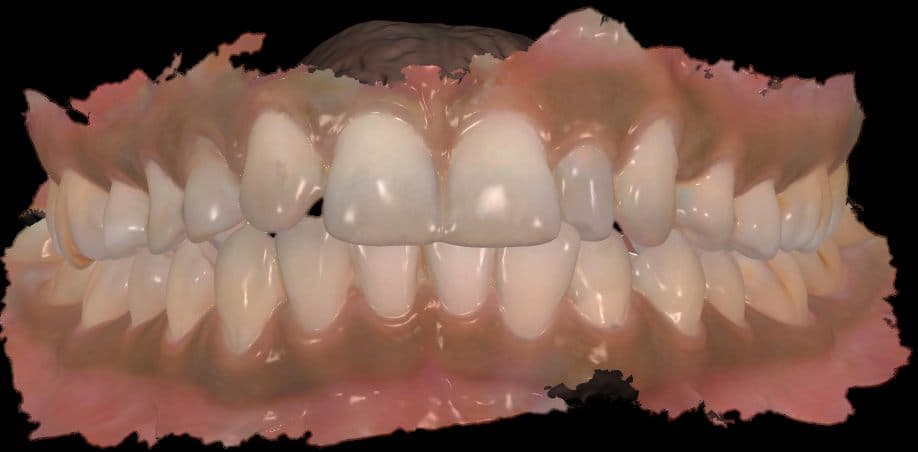
01 Reading what is actually there
This case had a baby canine that never came out, a permanent canine grown into the position the lateral incisor should occupy, that lateral still unerupted in the bone, and the lateral on the other side displaced out of the arch. A digital scan records all of it, so the plan is made against the mouth as it is rather than as it ought to be.
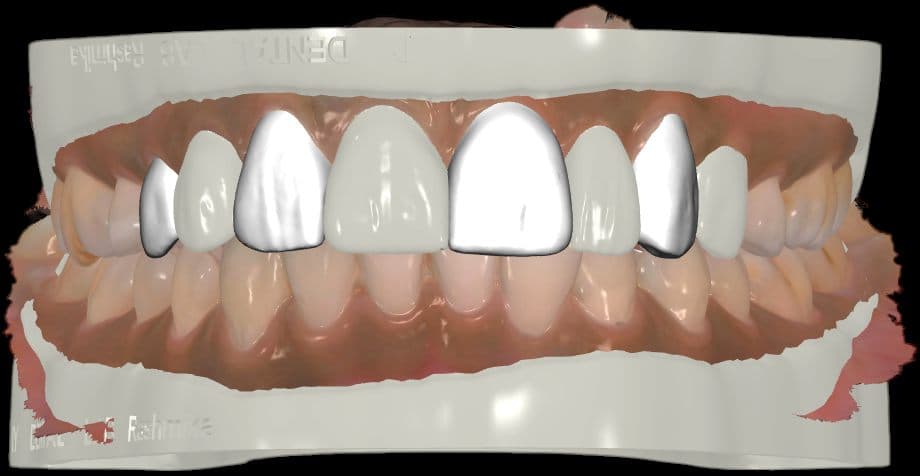
02 Designing the result before touching a tooth
Each tooth is designed to read as the tooth it should have been: the retained baby canine shaped to look like the permanent canine, the permanent canine shaped to look like the missing lateral incisor, and the displaced lateral brought into the smile line. The design is agreed on screen first, which means the finished shape is a decision rather than an outcome.
03 Building the palatal shell
A putty index taken from the design is used to build the back surface of each tooth first, in composite. That thin shell is what everything else is built forward from, and it is why the front surface ends up exactly where it was designed to be rather than where it happens to land.
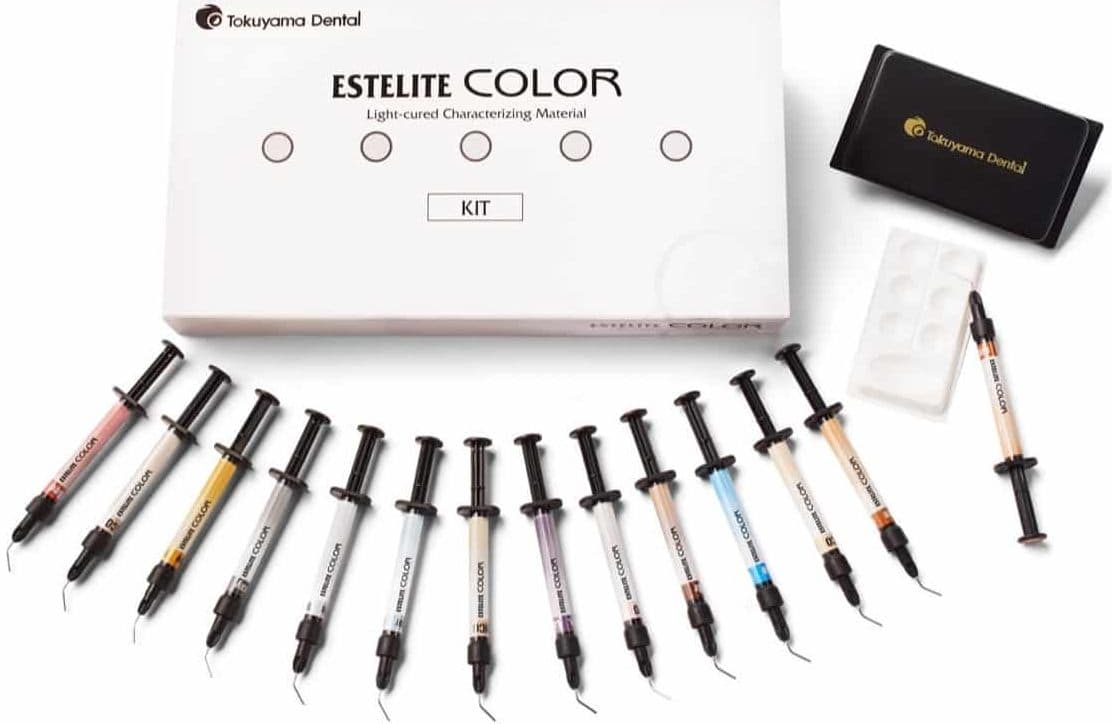
04 Painting the incisal characterisation
Before the front surface goes on, the biting edges are characterised by hand with a fine brush and colour tints — a little blue for translucency at the edge, opaque white where a natural tooth is more chromatic. This is the step that stops a set of veneers looking like a set of veneers.
05 Injection moulding the front surface
A clear silicone index made from the design is seated over the teeth and injectable composite is flowed into it, then cured through the index itself. The composite arrives in exactly the shape that was designed, in one pass, instead of being sculpted freehand and hoped into symmetry.
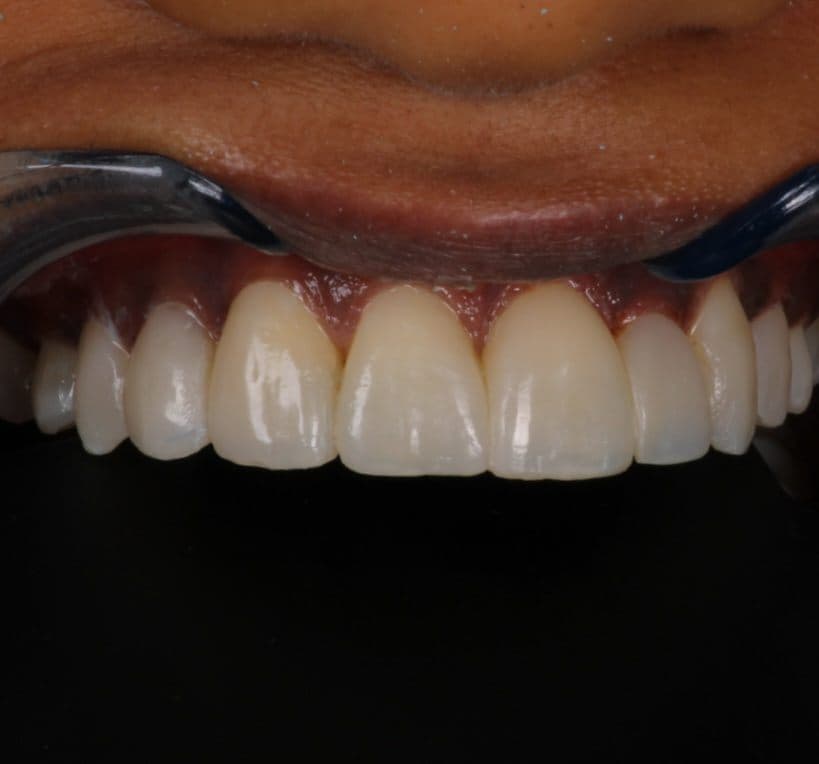
06 Anatomy and polish
The final surface anatomy is cut back in with burs, then polished in stages and finished with zirconium paste. Polishing is not cosmetic housekeeping: a composite surface that is properly polished stays cleaner, stains less and holds its shine for years rather than months.
Common questions
Do veneers ruin your natural teeth?
Composite veneers placed with minimal or no preparation remove little or no tooth structure. Porcelain veneers require enamel to be reduced permanently, committing the tooth to being restored long-term. The honest answer depends on which material and how much preparation is involved.
Can veneers be done in one visit?
Composite veneers are typically completed in a single appointment, since the resin is sculpted directly onto the teeth. Porcelain veneers need at least two visits because they are made in a dental laboratory between appointments.
Will my veneers stain or go yellow?
Composite resin picks up surface stain over time, particularly with coffee, tea, red wine and tobacco. Much of it can be removed by professional polishing. Porcelain resists staining better. Neither material responds to whitening once placed.
Can a chipped veneer be repaired?
A chipped composite veneer can usually be repaired in the chair without replacing the whole veneer, which is one of the material's practical advantages. Fractured porcelain generally cannot be patched reliably and is replaced instead.
Should I whiten my teeth before getting veneers?
If you want a lighter overall result, yes. Veneers are matched to the shade of your teeth at the time they are placed and will not lighten later, so whitening afterwards leaves the veneers looking darker than the surrounding teeth.
How many veneers will I need?
It depends on how many teeth show when you smile and how the shades and shapes need to balance. Treating too few can leave an obvious mismatch. This is assessed with photographs at consultation rather than decided in advance.
Evidence and further reading
- Lim TW, Tan SK, Li KY, Burrow MF (2023). Survival and complication rates of resin composite laminate veneers: a systematic review and meta-analysis. Journal of Evidence-Based Dental Practice 23(4):101911 · doi:10.1016/j.jebdp.2023.101911
Seven studies pooled, follow-up from two to eight years. Overall survival across the randomised trials was 88% (95% CI 81–94%), and directly placed veneers survived better than laboratory-made composite ones. The commonest problems were surface roughness, colour mismatch and staining at the margin — finish and appearance rather than the veneer coming off, which is why polishing and margin cleanliness get the space they do above.
- Mazzetti T, Collares K, Rodolfo B, da Rosa Rodolpho PA, van de Sande FH, Cenci MS (2022). 10-year practice-based evaluation of ceramic and direct composite veneers. Dental Materials 38(5):898–906 · doi:10.1016/j.dental.2022.03.007
1 459 veneers placed in one private practice and followed for ten years — a working practice rather than a trial, which is closer to your situation. Composite failed more often than ceramic: annual failure of 3.9% at five years and 4.1% at ten, against 1.4% and 1.2% for ceramic. Set against that, 17% of all the veneers were repaired and stayed in service, which is the trade-off described above — composite is the material that can be mended in the chair rather than remade.